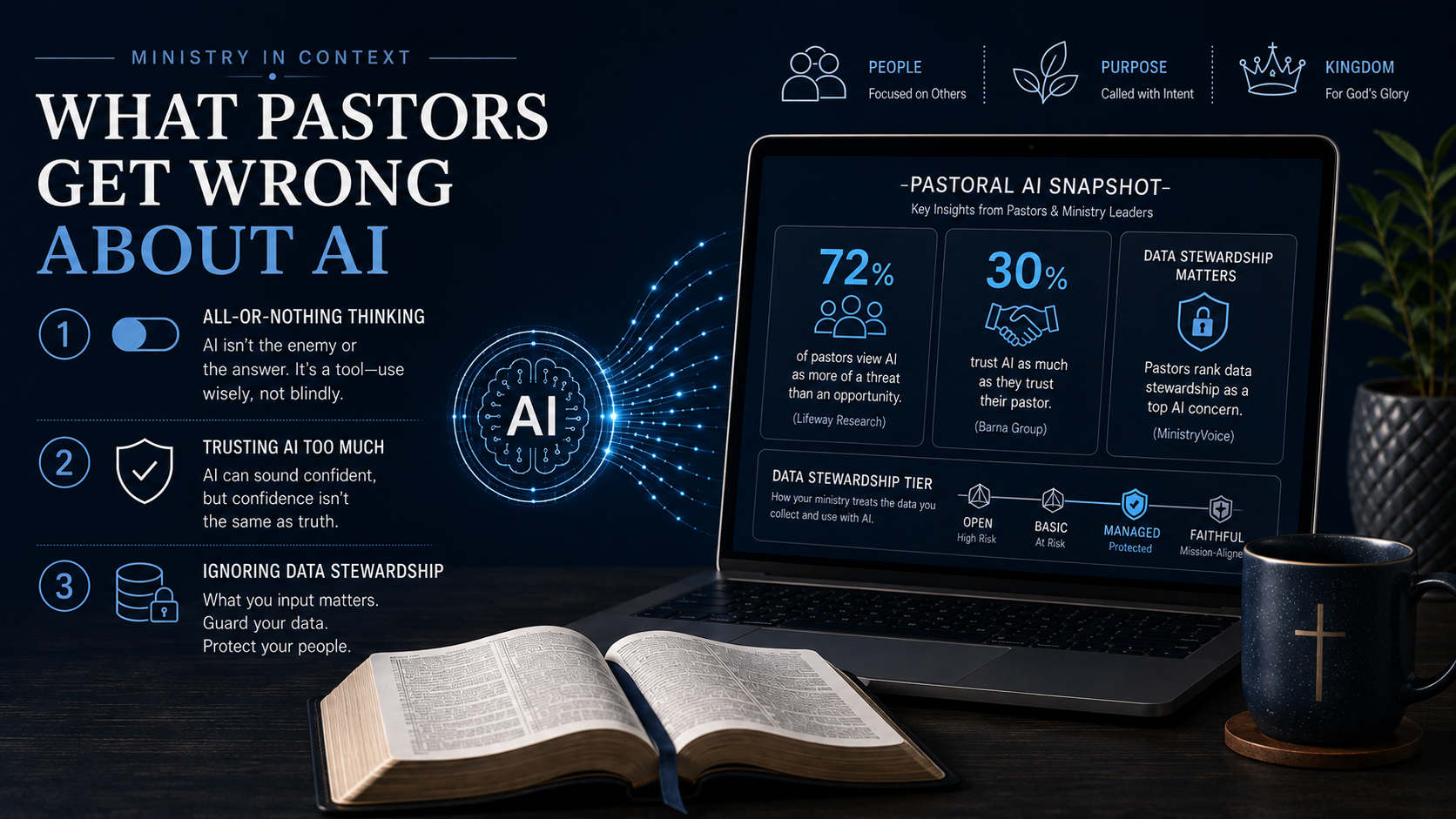
Summary: Most pastors are already using AI. Almost none have decided what they think about it. Here's what that gap is costing your congregation.
During my career in the military, cybersecurity industry, and church ministry, I've been entrusted with things people couldn't afford to have mishandled: classified systems, sensitive data, and the private stories congregants brought to my office. Different rooms, same responsibility: protect what wasn't mine to expose.
Most of what's written about AI and the church only comes from one of those rooms. The tech writers don't understand pastoral trust. The ministry writers don't understand what actually happens to data once you hit submit. I've sat in more than one of those rooms at once, and the gap between them is where churches are getting hurt.
Here's what pastors get wrong.
Misconception 1: It's an All-or-Nothing Decision
Walk into most pastoral conversations about AI and you'll hear one of two positions: full embrace or full resistance. Neither matches what pastors are actually doing.
Barna's December 2025 survey of Protestant pastors found only 13% aren't using AI at all. Half use it for brainstorming. A third use it for research on biblical or theological topics. Nearly a quarter now use it in writing or editing sermons, up from 12% just a year earlier. At the same time, 72% of those same pastors call AI a threat, 71% say they're cautious about it, and 40% describe feeling flat-out conflicted.
Lifeway's April 2026 research shows the same split from a different angle: 10% of pastors call themselves regular AI users, 32% are experimenting, and 18% are sitting on the sidelines waiting for better examples before they commit either way.
Read those numbers together and the picture is clear: most pastors are already using the tool while holding the position that the tool is dangerous. That's not caution. That's using something you haven't decided how to think about yet.
The mistake isn't fear and it isn't enthusiasm. It's the absence of a framework sitting between them. A framework tells you what AI is for in your ministry, what it's never for, and where the line sits. Without one, you end up exactly where the data says most pastors are: using it anyway, uneasy about it, with no stated position your staff or your congregation can actually follow.
Misconception 2: AI Is a Productivity Tool, Not a Trust Competitor
Most pastors think about AI in terms of what it can do for their to-do list: draft the newsletter, summarize the meeting, outline the sermon series. That's a legitimate use, and I've written about it before. But it misses what's actually happening in the pews.
Barna's research on AI as spiritual authority should stop every pastor reading this: 30% of U.S. adults now agree that spiritual advice from AI is as trustworthy as advice from a pastor. Among Gen Z and Millennials, that number climbs to two in five. Among practicing Christians specifically, 34% say the same, and 48% say they'd trust AI to help with their spiritual growth. Only 12% of pastors say the same about AI helping their own spiritual growth. Your congregation trusts this technology with something you were ordained for, at a rate roughly four times higher than you trust it yourself.
Here's the part that should get a pastor's attention: a third of practicing Christians say they want guidance from their own pastor on how to navigate AI. Only 12% of pastors feel ready to give it. That gap doesn't close itself. It gets filled by silence, or it gets filled by the AI tool itself, answering questions about faith and life that used to come to your office.
This isn't hypothetical concern. 94% of pastors worry that AI misinterprets Scripture, and nearly two in three practicing Christians worry about AI beginning to function as a replacement for God in their lives. Your people already see the risk. What they're waiting on is leadership, not a warning they could get from a headline.
AI in ministry isn't just a tool competing for your time. In the minds of a growing share of your congregation, it's a voice competing for the trust that's supposed to be yours to steward.
Misconception 3: Member Data in AI Tools Is No Different Than Notes in a Filing Cabinet
This is the one I want to spend the most time on, because it's the one my ISSM background sees clearly and most ministry writing on AI doesn't touch at all.
Pastors and church staff are pasting sensitive information into free, consumer-grade AI tools the same way they'd jot something in a private notebook. It isn't the same, and the difference matters more than almost anything else in this conversation.
The categories of data involved in most church data breaches, giving records, pastoral care notes, household information, member identifiers, are the exact same categories now getting typed into AI chat windows for "help drafting a stewardship letter" or "summarizing this counseling conversation." Once that data leaves your hands, you're operating under someone else's terms of service, not your own data-handling policy, and most staff have never read the terms of service for the tool they're using every day.
Here's a concrete example, and I'll use the tool I actually recommend to make the point, because credibility means naming it even when it's inconvenient: as of August 2025, Anthropic (the company behind Claude) changed its consumer terms so that chats on the Free, Pro, and Max plans are used to train future models by default, with retention extended up to five years, unless the user actively opts out. That's not a criticism of Claude specifically; every major consumer AI tool made a similar move. It's the point. "I didn't know" is not a defensible position for a steward of other people's information, and it's an even less defensible position for a pastor whose calling includes protecting the people who trusted him with their story.
This is a stewardship issue before it's a technology issue. You already treat counseling notes, giving records, and prayer requests as things you don't hand out casually. AI tools deserve the same instinct, not a suspension of it just because the interface feels like a conversation instead of a database.
What this looks like in practice:
Set a plain rule and put it in writing: names, financial details, and pastoral care specifics don't go into a public, free-tier AI tool. Ever. If a task genuinely needs that level of detail, use a business or enterprise tier with an actual data-protection agreement, not the free version everyone already has on their phone. Before your staff adopts any AI tool for church use, someone (you, an IT-minded volunteer, or a consultant) actually reads the data-training and retention terms, not just the marketing page. And if you're already using AI in staff meetings or admin work without any of this written down, that's the gap to close this month, not next year.
Why This Matters for Your Congregation
Put the three misconceptions together and the pattern is the same: pastors are moving on AI without a framework, without addressing the trust vacuum it's creating, and without treating member data like the sensitive material it actually is.
Your congregation isn't waiting for you to catch up. They're already using AI, already trusting it with questions that used to come to you, and in some cases already more comfortable with it spiritually than you are. Meanwhile the data your church holds, the same data you'd protect instinctively on paper, is moving through systems most churches have never evaluated.
The fix isn't rejecting AI and it isn't adopting it faster. It's leading it: a stated position on what it's for, a stated position on what it's never for, and a data policy that treats digital information with the same seriousness you'd give a locked filing cabinet. Pastors who do that now are the ones whose congregations will trust them with the next question AI raises, because they already led them through this one.
Where to Start
Don't try to write a comprehensive AI policy this week. Start with the smallest, highest-risk gap: get a one-line rule in front of your staff about what never goes into a free AI tool, this week, verbally if that's all you have time for. Then build the fuller framework and the trust conversation around AI's role in spiritual guidance from there.
Where is your church right now: no policy, an informal rule nobody wrote down, or something on paper? Drop it in the comments, I want to know how far the gap actually runs.