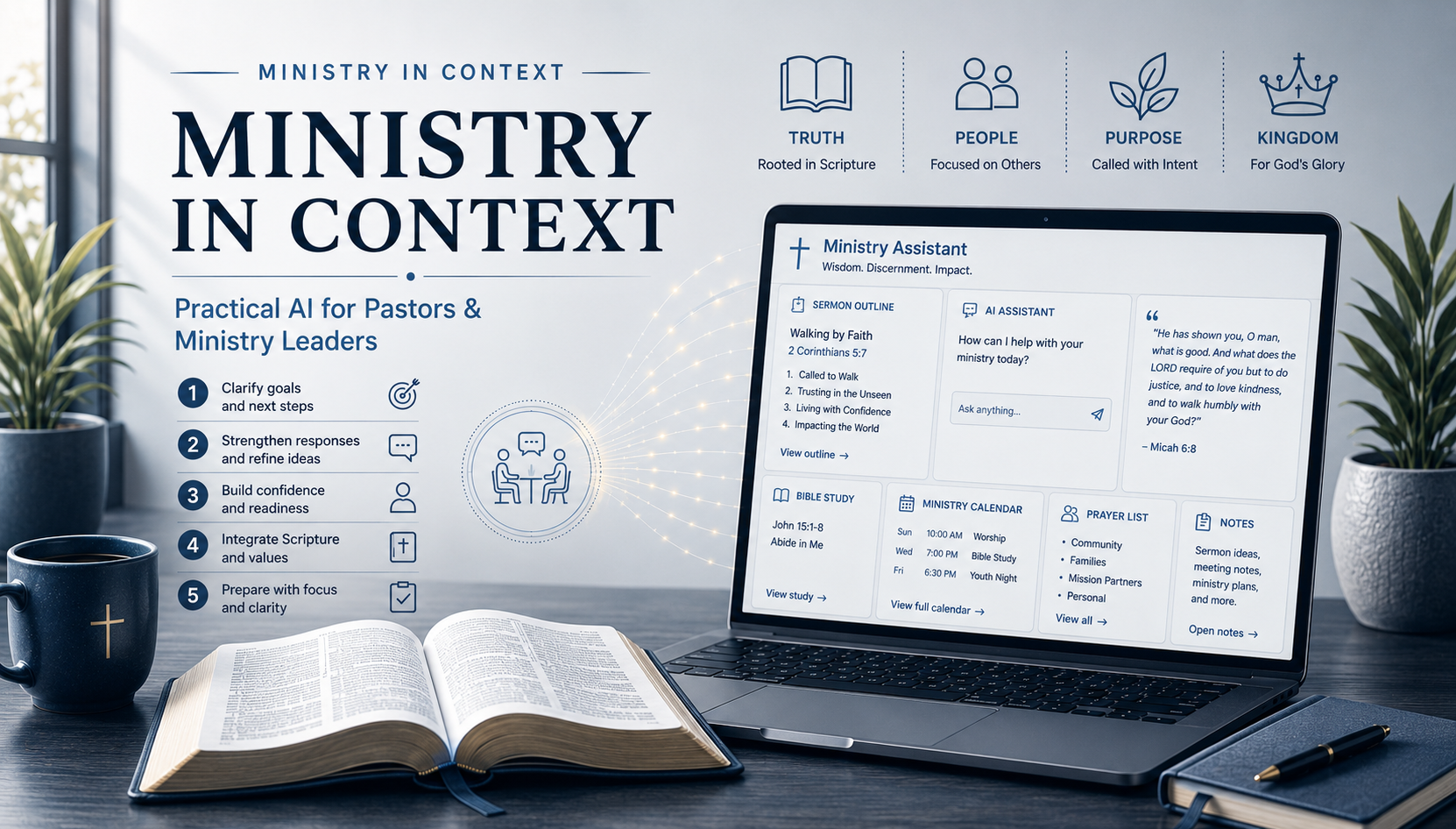
Before You Build One, See What It Looks Like When It's Done
I want to show you what you're building before you build it.
I am a cybersecurity professional by day and a minister by calling. I spent 20-plus years in both worlds simultaneously: church planter, senior pastor, IT practitioner, trainer. When I started using AI seriously, I ran into the same wall everyone hits — generic output that didn't sound like me, didn't fit my context, and required more editing than it saved.
So I built a profile.
I pulled my spiritual gifts assessment results and loaded them in. I documented my communication voice across the different registers I operate in: devotional writing, teaching, professional correspondence. I wrote out my role, my calling, and my current focus. Then I did something most people skip. I interviewed my family. I asked my wife, my kids, my brother, my nieces and nephews how they actually experience my leadership and character. I took their exact words and put them in the profile.
The result is an AI that knows I make decisions through a Kingdom lens before a professional one. It knows I'm wired as a Guardian — I ask hard questions and want evidence before I commit. It knows I write devotionally in first person with a bridge technique: start with something observable, connect it to a Kingdom principle. It knows I carry both a cybersecurity brain and a pastor's heart, and that those two things are not in conflict.
Every interaction builds on that knowledge. I don't re-explain myself. I don't rewrite generic output. I work.
That is what you're building.
The profile draws from five sources — your gifts and wiring, your voice, your role and calling, how others actually experience your leadership, and what's happening right now in your ministry. Part 3 shows what that looks like in practice: real task comparisons, before and after context is loaded.
Ready to build your context profile?
Book a session and we’ll walk through the five-source framework together — most leaders have a working profile in about 30 minutes.