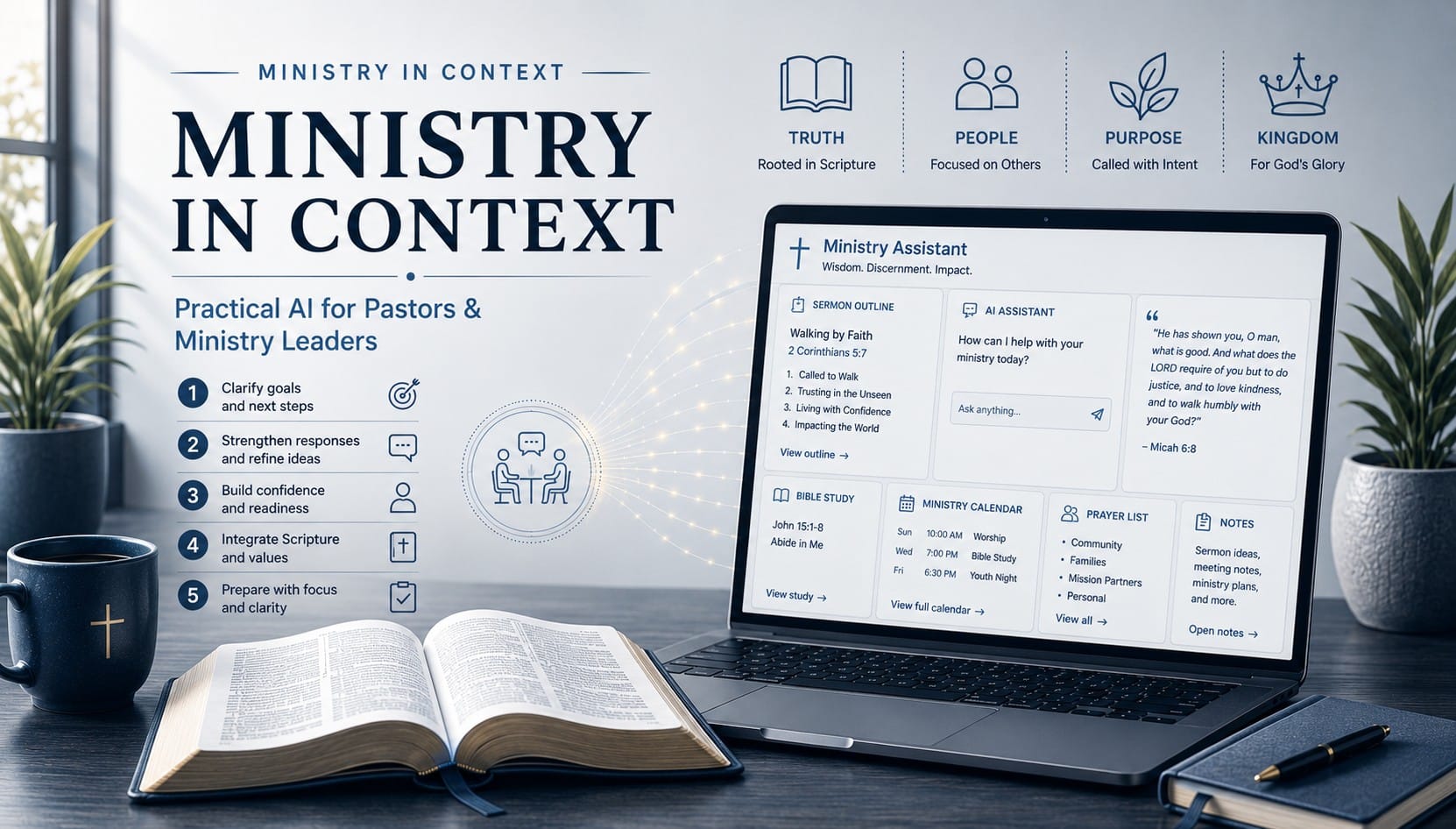
The Problem With How Most People Use AI
You've tried it. You opened Claude or ChatGPT, typed a question, and got a response that was technically fine but felt like it came from someone who had never met you, never sat in your congregation, and had no idea what you actually carry.
So you tried again, this time with a better question. You rephrased it. You added detail. You searched online for the right way to ask. Maybe you found a list of "100 prompts for pastors" and worked through a few of them.
And the results were still generic.
Here's what most people miss: the problem was never the question.
The Real Issue: AI Doesn't Know You
Think about the difference between calling a hotline and calling someone who has known you for ten years.
The hotline gives you accurate, competent, completely impersonal answers. It does not know your history, your convictions, your communication style, or the specific weight of your assignment. It answers the question you asked — nothing more.
The person who knows you does something different. They hear what you asked, connect it to what they already know about you, and give you an answer that fits your life: your voice, your situation, your next step.
That is the difference between a prompt and a context profile.
A prompt is a question. It tells AI what you want in this moment.
A context profile is a relationship. It tells AI who you are: your gifts, your voice, how you think, how you lead, what you carry, and what you're building. Every response from that point forward is shaped by that knowledge.
Most people are spending their energy trying to write better questions. The leverage is in building a better relationship.
Why This Matters More for Ministry Leaders
Administrative work does not disappear in ministry. It multiplies. The larger the congregation, the more complex the organization, the more time gets consumed by tasks that were never the reason you said yes to this assignment.
Email follow-up. Meeting notes. Board reports. Volunteer coordination. Announcement drafts. Curriculum research. Budget summaries. Pastoral care correspondence.
None of that is the ministry. All of it is necessary.
AI can handle significant portions of that load, but only if it knows you well enough to handle it in your voice, with your values, for your specific context. An AI that doesn't know you will produce output you have to rewrite. An AI that does know you produces output you can send.
The difference is not the tool. The difference is the context you give it.
Part 2 covers what actually goes into a context profile and what changes once yours is built.
Ready to build your context profile?
Book a session and we’ll walk through the five-source framework together — most leaders have a working profile in about 30 minutes.